The Commencement season

Jeff Nelligan • May 23, 2023

Doing not dreaming. Get the small stuff right.

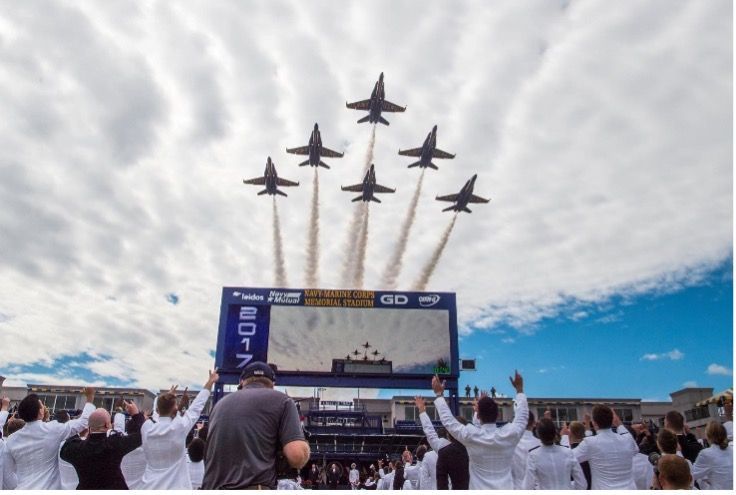
Annapolis, Maryland – Right this moment, the Blue Angels (pictured above) are thundering over my home as the pilots practice for the U.S. Naval Academy graduation later this week. Virtually anyone who sees these six wonders of American genius and technology silhouetted against a clear sky feels an intuitive sense of patriotism and, yes, freedom. Those individuals who don’t? Well, they’re allowed to do so precisely because these jets exist.


It's Commissioning Week in Annapolis and the graduation moment for youths all over the nation, an ideal time to reflect on deserved achievement and equally important, on finding the road ahead. One milestone shared by all is the commencement address and its insights. 


Over the days and years I’ve been to a fair share of graduations, 12 for my three sons, four of my own and 11 for friends and their kids (but hey, whose counting?!). I‘ve even write a few addresses for the politicians for whom I’ve worked.


From all these experiences, I’ve observed there are essentially two kinds of addresses offered: From those who have actually achieved something concrete and impressive in their lives, and those who haven’t. 


Alas, my own graduation years ago from – let’s call the institution Faber College - fits in the latter category. It featured an obscure United Nations’ official as the Commencement speaker (some mercy is due the poor man – he was a stand in; Leonard Bernstein was scheduled but fell ill) who was “excited” to tell us all about his simply fascinating bureaucratic career and his “heroic” fight at Foggy Bottom and Turtle Bay against the long march of American imperialism and capitalism. 


"That fellow seemed rather high on himself,” my mild-mannered father observed afterwards. Yep, Dad - a successful self-made man who at age 15 worked in a vanadium mine in Nevada and at 18 took part in the invasion of Okinawa and later spent four months patrolling the streets of Tokyo as part of the occupation force, even as the UN was being formed in San Francisco and Dr. Bureaucrat was patrolling library shelves at Big Bad State. Hey, who knew?! My laid-back old man - both a capitalist and an imperialist! 


This unfortunate tone of self-righteousness had not dissipated when years later, it was time for my eldest son to graduate from Faber. His commencement speaker was an immigrant Nigerian poet and a few moments into her remarks she casually informed the crowd: “If you were born a straight white male or female, well, congratulations, you hit the jackpot.” 

You poor woman, I thought to myself, are you aware this is a commencement address, not a faculty lounge?


But our “brave” speaker – because that was what she told us she was, donchaknow – plowed on in the same fashion “…you need to stand for social justice and the voiceless…remake America…” 


Yikes, sister! Did you feel this way before you fled the slums of Nsukka for jackpot America?! And is it really wise, at such a celebratory event, to immediately insult three-quarters of your audience? You know, those sad sack parents and alums who have collectively contributed to the institution’s national preeminence and financial security so that full tuition and board are gifted to the, ahem, non-privileged? 


By midpoint of her speech, exactly as it had happened during my graduation decades ago, the bleachers were half empty; the lotto winners had gathered elsewhere, no doubt to trade gambling stories. 


As I said, the limited, even incomprehensible speeches come from the mediocrities; the really good ones come from those who have firmly engaged the world, performed at the tough jobs, have hit the obstacles, and have succeeded.

Here are three…


An absolute knock-out speech was given by Shonda Rhimes at Dartmouth College in 2014. Rhimes is a famous American television screenwriter, best known as a showrunner - creator, head writer, and executive producer of numerous popular shows. 


She was blunt – she  told grads to stop dreaming and start doing. “The world has plenty of dreamers. And while they are busy dreaming, the really happy people, the really successful people, the really interesting, engaged, powerful people, are busy doing. So ditch the dream and be a doer, not a dreamer. Whether or not you know what your ‘passion’ might be. The truth is, it doesn't matter. You don't have to know. You just have to keep moving forward. You just have to keep doing something, seizing the next opportunity, staying open to trying something new."


Bang! Ditch the introspection – get moving!.


A second favorite was Admiral William McRaven's University of Texas commencement address, again in 2014. He spoke about his first days of Navy SEAL training:


“Every morning we were required to make our bed to perfection, a mundane task. It seemed a little ridiculous at the time, particularly in light of the fact that were aspiring to be real warriors, tough battle-hardened SEALs, but the wisdom of this simple act has been proven to me many times over. If you make your bed every morning you will have accomplished the first task of the day. It will give you a small sense of pride, and it will encourage you to do another task and another and another. By the end of the day, that one task completed will have turned into many tasks completed. Making your bed will also reinforce the fact that little things in life matter. If you can’t do the little things right, you will never do the big things right.”


Doing, not dreaming. Getting the small stuff right. Two of the most important pieces of advice for that road ahead, whether you’re nine-years old or 19.  


As I noted, this is Commissioning Week here in Annapolis and it recalls the my third favorite commencement speech, given by President Trump at my middle son’s 2018 graduation from the Naval Academy. Whatever your thoughts about the man, he met the moment and exceeded it.


The audience of parents and relatives and friends knew what the graduating Midshipmen had endured for four grueling years: No-excuse military discipline, barracks life, four straight summers of training deployments and mandatory softball courses like Electrical Engineering, Calculus and Thermodynamics. Twenty percent of the entering class never made it to graduation because unlike the “safe spaces” of Faber, failure at USNA has consequences. Seventy-five percent of the class (including my son) were STEM majors. And funny, unlike Faber, there were no majors in Latinx Gender Studies. Those Mids, like my sons, would soon be in charge of ordnance that could reduce a thousand voiceless bad guys to ashes in a social justice instant.


Simple and profound, the President brought it in hard and fast to the Midshipmen.  “You have taken the path of hard work and sweat and sacrifice….the word impossible does not exist for you because the Navy never quits. You are now leaders in the most powerful and righteous force on the face of the planet!” 


Thankfully, no fatuous shots at imperialism and capitalism from a third-level career bureaucrat drone; no remaking of America from a fatuous Third World immigrant.


Just pure sound and fury: “You’re among the finest people anywhere in the world, the smartest, the strongest! You know you will make us proud. You are warriors. You are fighters! You are champions!”


And then here they were, like in the photo above, blasting the same thunder I’m now hearing five years later as I heard it then. Practically touching the rim of Navy-Marine Corps Stadium is the unbelievable winged force of the Blue Angels streaking over the crowd at 200 mph with yes, the sound of freedom. 


                                                                                                           #####

ABOUT THE BOOK

Every Dad in America wants to raise a resilient kid. Four Lessons from My Three Sons charts the course.  

Written by a good-natured but unyielding father, this slim volume describes how his off-beat and yet powerful forms of encouragement helped his sons obtain the assurance, strength and integrity needed to achieve personal success and satisfaction. This book isn't 300 pages of pop child psychology or a fatherhood "journey" filled with jargon and equivocation. It's tough and hard and fast. It’s about how three boys made their way to the U.S. Naval Academy, Williams, and West Point – and beyond.
GET THE BOOK NOW
By Jeff Nelligan May 22, 2026
It was a small cemetery reached by an unpaved country road near Hebron, a Maryland town named after the city south of Jerusalem known as a burial ground for prophets. Ten years ago this month my old platoon leader, U.S. Army Master Sergeant Stephen “Smitty” Smith was buried with full military honors - four soldiers in dress blue uniforms carrying a flag-draped casket while a volley of shots were fired and Taps sounded. Alas, it’s a ritual that has been carried out many times since Smitty’s funeral. Smitty’s military career spanned a quarter century of American conflict - the Cold War, post-Cold War European turmoil and Islamic jihad. He was in Germany at Bad Aibling Station in 1985 as an enlisted soldier serving with a detachment intercepting Soviet and East German transmissions. He left active service, went to college and then joined the Maryland National Guard where I met him in the 629 th Military Intelligence Battalion, a Cold War-focused unit which exists no more. The First Gulf War in 1991 passed over the battalion but then there was a need for troops to police the turbulent Balkan states. Smitty volunteered in 1999 and deployed to Bosnia for more than a year. Then came 9/11 and because of the wars in Afghanistan and Iraq, manpower was stretched worldwide and in 2003 Smitty deployed again with the National Guard when the battalion sent a company of solders to Kosovo. Smitty served many years as a Non-Commissioned Officer (NCO), whose creed rightly establishes them as the “Backbone of the Army,” the human bridge between officers and enlisted soldiers. Says the creed: “My two basic responsibilities will always be uppermost in my mind—accomplishment of my mission and the welfare of my Soldiers.” A simple but a profound leadership charge. I saw those NCO leadership qualities up close as an enlisted Army Reservist then Army Guardsman for 14 years. And yet, I still find it difficult to properly explain to my non-service peers the deep military ethic behind such leadership - the sense of duty and loyalty, the cohesion of diverse units (my battalion was majority-minority) and the camaraderie that fostered performance and accountability. Of course, compared to the vast majority of servicemen and women, my military service was modest, mostly composed of maintaining Humvees, cleaning weapons, and performing administrative tasks. However, my three sons are active-duty military officers; two of them lead dozens of enlisted men and women and work with complex equipment (some of it lethal) worth hundreds of millions of dollars and have been in tight situations that are unfathomable to their non-military peers. My sons depend heavily on the Smittys of this world. Even after the grind of patrols in Kosovo Smitty hung in there and in 2007 deployed to Iraq to work in an intelligence role, the same job he’d had at Bad Aibling Station 22 years and several new world orders prior. He came back a year later and his closest friends immediately knew something was wrong. He isolated himself and when he did emerge, he was erratic in behavior and a changed man. He hadn’t been in combat in Iraq; the closest to danger he’d come was when one evening several Iraqi soldiers on his base haphazardly fired hundreds of rounds into the sky and dozens of bullets rained down through a large tent in which Smitty was attending a briefing, injuring several soldiers. At the beginning of 2012, he was found dead in his home of “natural causes” according to the Anne Arundel County coroner. At the funeral, his mother was defiant that “the war killed my son.” His sister insisted it was PTSD from Iraq, somehow amplified by his previous two deployments. A dozen guys from the old unit gather in the cemetery parking lot after Smitty’s burial, smoking cigarettes and drinking coffee and all of us are still shaken by the anger and rage of his Mom and sister. None of us knew what exactly had happened. And as with all guys who’ve served closely in a military unit, there was no lack of candor. One senior NCO, a real hardass though grudgingly admired, had driven 130 miles that morning to Hebron and he said, “Look, guys, you all know Smitty didn’t really like me at all and I didn’t really like him. We had some real blowups in Kosovo and at Victory [Camp Victory in Iraq] and all those rounds through the tent put us even more on edge. But I knew he respected me and I respected him.” Regret was the dominant sentiment. Why hadn’t we made more of an effort to see Smitty? To all these guys, mostly vets with an experienced outlook on service, it was a mystery. One thing though: The anger of his mom and sister pounded in our heads. The U.S. Department of Veterans Affairs notes that Post-Traumatic Stress Disorder was a “significant public health problem in Operation Enduring Freedom and Operation Iraqi Freedom (OEF/OIF) deployed and non-deployed Veterans” with studies that show “15.7% of OEF/OIF deployed Veterans screened positive for PTSD compared to 10.9% of non-deployed Veterans. Overall, 13.5% of study participants screened positive for PTSD.” For the National Guard, the PTSD number is 14.5 percent of deployed troops. The U.S. Department of Defense Casualty Status report for Iraq and Afghanistan still updated weekly, lists 4,431 U.S. deaths in Iraq and 2,352 in Afghanistan. On this Memorial Day, we honor the more than 1.1 million men and women who are listed as the casualties of all the wars fought by America. But as one of my old battalion comrades – himself an NCO - said in the cemetery outside Hebron, sometimes there can be a different kind of casualty of war. ____________ Jeff Nelligan is the author of "Four Lessons from My Three Sons - How You Can Raise Resilient Kids"(https://www.amazon.com/Four-Lessons-Three-Sons-Resilient/dp/B0C9SB2NLX) and lives in Annapolis, Maryland,
By Jeff Nelligan May 16, 2026
Doing not dreaming. Getting the small stuff right. And spare us the lectures on privilege.
By Jeff Nelligan April 29, 2026
Welcome future Justice Warriors!
By Jeff Nelligan April 21, 2026
The most complex character in American cinematic history.
By Jeff Nelligan April 15, 2026
Douglas C. Neidermeyer, Membership Chairman, Omega Theta Pi
By Jeff Nelligan April 8, 2026
He discusses his inspiration for satire and the enduring appeal of “Animal House.”
By Jeff Nelligan March 31, 2026
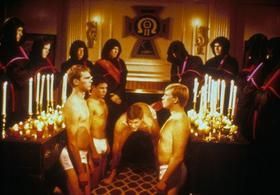
We begin at the very beginning. Where else? It’s an early autumn evening and two excited freshmen saunter under the swaying elms lining the Faber College quad. It’s fraternity Pledge week and Larry Kroger and Kent Dorfman are on their way, theoretically, to meet new friends and share cheerful bonhomie, forge lifelong bonds and celebrate virtuous brotherhood all around. Nothing could be further from the truth. These two pilgrims are actually beginning a Homeric Odyssey of the Innocents through the Faber Greek system, at the end of which they will emerge…but hey, let’s not get ahead of ourselves. Now, imagine holding to your eyes a kaleidoscope displaying an array of shifting scenes following our unwitting frosh duo, who serve as the chief catalysts of the film. Along with other chief catalysts. Who are they? Let’s find out. ______________________ “I, state your name…” Up the steps of a fashionable residence they stroll and a door opens into the Nietzschean hell of Omega Theta Pi. “Hi there, Doug Neidermeyer. Omega Membership Chairman.”  This wonderfully patronizing voice foreshadows the rocky road ahead for our heroes. While sneering at Larry, Neidermeyer shuts the door on Kent’s head. Moments later, Omega Name Tag Hostesses Mandy Pepperidge and Babs Jansen cruelly take stock of the two, the latter voicing the endearing line that adorns this chapter. Forcefully guiding them away from the white Anglo-Saxon super-race of winners in the main room, our Membership Chairman delivers Larry and Kent to the nearby Third World sitting room where overt racism, antisemitism and ableism reach an instant and shocking peak. “Hi there fellas,” says Neidermeyer to the room’s hapless occupants, “I’d like you to meet Ken and Lonnie. Ken, Lonnie, let me introduce you to Mohammad, Jugdish, Sidney and Clayton.” Baleful stares emanate from the unfortunate trio on the couch and the inhabitant of the adjoining wheelchair. Then with his sphinxlike smile Neidermeyer adds, “Now, just grab yourselves a seat and make yourselves at home.” He forcefully pushes Lonnie onto the couch and then pats the corpulent Ken on the stomach while uttering one of the most vicious lines of the film: “And don’t be shy about helping yourself to the punch and cookies.” Spine-tingling action presaging the epic battles to come. Indeed, you can almost see the blind and crippled Clayton come to life. But hold on. Kent escapes this obvious trap to wander into the A-Listers piano lounge where Omega President Greg Marmalard, regency pipe in hand, holds forth to future shock trooper Chip Diller. Let’s listen in: “Now I’m not going to say Omega is the best house on campus. But a lot of outstanding guys figure they’ll pledge Omega or they won’t pledge at all. We do have more than our fair share of campus leaders. Something that never looks bad on your permanent record, Chip.” A pushy Chip Diller replies smarmily, “Well sure, everyone I talk to says Omega house is the best but…” Here Chip pauses and then continues, “I hate to seem you know, pushy…” Marmalard breaks in knowingly. “Let the unacceptable candidates worry about that because after tonight – “ Suddenly a sweaty Dorfman lurches into view next to Chip and Greg concludes “…there you are.” Oozing a mixture of insincerity and guile, Marmalard doesn’t miss a beat. He politely introduces Kent to Mandy Pepperidge and Chip, “…and over there is Terry Arbock, captain of the swim team, and that’s Carl Philips, editor of the Daily Faberian. And over here…” Marmalard skillfully steers him back to the land of the misfit toys “…is Clayton, Sidney, Jugless, Muhammad, Lonnie.” “We already met,” says Kent dolefully. “Ah, super! Then you’ll have plenty to talk about!” We have glimpsed our pure anti-heroes, Doug and Greg, and the percolating evil of Omega House in just 53 seconds. Are the battle lines drawn in this epic? Not quite yet, but the pencils are being sharpened. Shaking themselves free of the obvious Omega winners, Larry and Kent are outside again trudging onwards while the latter takes aim at his comrade’s pessimism. “I don’t think you’re trying very hard,” Dorfman says in exasperation. But he finds solace as they approach the known fraternity next door inasmuch as his brother was a Delta. “They gotta take me. It’s like their law. Don’t worry, Larry. I’ll put in a good word for you.” Moments later, in what some scholars call the most riveting scene in the film, Bluto urinates on their shoes. Another kaleidoscope of images bombards us from which there is no turning away. Because here we have another door opened - again that crafty symbolism! – and Delta Tau Chi is revealed to our nascent pledges. It’s a world of absolute mayhem (some use the word “symbolic” as a contrast to the hushed tones of the uptight Omega tea party). The squalid dwelling’s walls are covered in graffiti and cheesy posters and stolen road signs, loud music (a contrapuntal to the Liberace next door) and deafening conversation, beer bottles explode in every room and soon a motorcycle* breaks through the front door and is driven up the stairs to the second floor. Kent interrupts a high-stakes card game and Larry gazes at the breasts of a water-filled mermaid. ____________________ Author’s note: Carefully perceive here how the maudlin “coming of age” youth syndrome, normally years in the making in American life, is compressed into mere moments in this film. Striking. _____________________ Dorfman is soon introduced by Delta Tau Chi President Robert Hoover to Delta Rush Chairman Eric Stratton and his sidekick, Donald “Boon” Schoenstein. “Ken’s a legacy, Otter” says Hoover earnestly, “His brother Fred was a ’59.” Flounder helpfully interjects. “He says legacies usually get asked to pledge automatically.” Otter responds. “Oh well, usually. Unless the pledge in question turns out to be a real closet case. Like Fred.” Flounder gasps, “My brother!” Consider: Within five minutes the entire cast – minus one – is introduced. How do the screenwriters do it? Good question. Let’s fast forward because we can. At the official Delta Tau Chi Membership Meeting photos of Larry and Kent are projected by a slide projector on a beer-soaked bedsheet, provoking derisive cries of outrage and the heaving of empties. But as one savvy brother observes, Delta needs the dues. It is here we are witness to a unicorn moment which has escaped previous scholars and maybe even my esteemed readers. Dorfman’s pathos-ridden mugshot is shown, prompting Otter to rise to his feet to address his Delta brethren and defend Kent’s obvious unsuitability for any fraternity any where. This is the sole moment of kindly grace we see will see from Otter in the entire film. Noteworthy, but fleeting. In the seeming next moment, Hoover is wearing pajama bottoms, a Santa Claus jacket and a Viking horned helmet and initiating the pledges with the sacred Delta oath. In between belches, Sergeant-at-Arms Bluto majestically reveals their brotherhood identities, which is followed by the obligatory fraternity bonding scene: beer suds flying in the air and drunk young men dancing together and butchering the lyrics of culturally appropriated music....
By Jeff Nelligan March 20, 2026
Emile Faber, President of Faber College - 1904
By Jeff Nelligan January 29, 2026
It's 8:30 a.m. on a humid August Tuesday and I’m on the roof of the U.S. Capitol, the Dome rising 280 feet directly above. In my arms is a stack of thin boxes and I’m navigating a plywood gangplank leading to a rusted 15-foot flagpole. A colleague joins me carrying more boxes. She opens one and hands me a 2’ by 4’ American flag which I affix to the pole’s lanyard, raise and lower quickly, unfasten and hand to her as she hands me another. A third colleague brings out more boxes and retrieves the ones containing flown flags. This little dance continues for three straight hours. Afterwards, my colleagues and I carefully re-fold each flag and affix to it a “Certificate of Authenticity from the Architect of the Capitol” reading “This flag was flown over the U.S. Capitol in honor of____” and fill in the blank: “The Greater Bakersfield, California Chamber of Commerce”…the 80 th birthday of Wilbert Robinson of Bowie, Maryland, proud veteran of the Vietnam War…” We will perform this task for five days a week until Congress returns from recess. This is my very first job in Washington, D.C. and obviously, I have what it takes. *** Flag duty began my 32-year run in politics and government, which ended last week. It included four tours of duty on Capitol Hill working for three Members of Congress, two Presidential appointments serving Cabinet officers in the Departments of State and Health and Human Services, posts at two independent agencies, and a career position at FDA. The jobs were a mix of purely political positions where being on the south side of an election meant cleaning out your desk and getting good at catchy LinkedIn posts – twice that happened - and career federal government stints where the stakes were less exhilarating. *** I worked principally as press secretary and special assistant. The former job, a common D.C. occupation, was transformed in 2008 with the onset of social media, morphing from daily pronouncements of your boss’s wisdom on the issues of the day to rapid-fire postings on the obvious unreasonableness, even cruelties of your opponents. Sound familiar? As for the latter occupational specialty, special assistant, the terms ‘bagman’ or ‘fixer’ are more apt: A guy always two steps behind the principal but always ready to step up and fix whatever problem arose in daily political life. Need a special vegan lunch for Congressman Busybody, White House tour tickets for the Big Bad High volleyball team, or the personal phone number of the executive assistant to a heavy-duty lobbyist? I was your guy. Every leader needs a fixer. Like anyone else who works in D.C., I occasionally participated in a glam political moment – you know, that unique, epic event that would never ever be forgotten in D.C. history Until it was. *** The best part about government life was working for many men and women who were at the top of their game in the D.C. Swamp, one of the toughest arenas on the planet. Their success, from the vantage point of your humble correspondent, was attributable to four simple rules of life. “If you can’t measure it, it didn’t happen.” Every office I was in kept metrics on virtually every aspect of the principal’s week – how many meetings and events attended, X posts, interviews, committee votes, constituent letters, action items completed from memos?! Numbers, numbers, and always keeping score – and always the quest to improve. “Never lose it.” In a lifetime of political jobs, I may have heard a boss raise her or his voice half a dozen times, even during and after major-league setbacks. Self-control was their hallmark. One boss, a powerful House Committee chairman once confided to me, “I’m fine that 80 precent of my job is humoring these guys, no matter how crazy they get.” An equally valuable corollary skill: Humility. The ability of these individuals to admit to colleagues and staff when wrong on a particular issue. Which counterintuitively only upped their long-term credibility. “Something’s always gonna go south.” Always the need for a plan C. Every initiative during an upcoming day was scoured for what elements would interfere and how, if they occurred, they could be ameliorated. Hence, in the rare times when things did go south, there was always preparation in advance for getting to 80 percent of what was needed. “Good is not good enough.” Successful politicians and government leaders – and their staffs – never get complacent. If they do, they’re not long for the Swamp. Everyone is always hustling for the edge. A useful corollary learned from an NCO when I was in the Army: Always have your hand up. Volunteering is at the heart of the hustle, the cheerful willingness to take on the new and unknown and do whatever it takes. *** And that’s how it all started. On the second day of my first congressional tour the Member solicited volunteers “for a fun recess job that’ll get you out of the office.” It was flag duty and from that day onwards my government career could only go up. *****
By Jeff Nelligan September 10, 2025
It's all about the hustle and grind