Five bold perspectives parents can take as their kids play youth sports.

Stephen Borelli
USA Today/January 6, 2024
Jeff Nelligan says he attended about 2,300 of his three sons’ games over 22 years.
When they played on school teams, he would wear a jacket and tie or a suit as he watched them. “I know how hard you work to get better, all the hours and practices,” Nelligan, who has become a noted commentator on American parenting, recalls telling his boys. “These games are important to you and the wins are huge and the losses hurt. So when
I show up dressed up nicely, it’s my way of showing you and your team the respect you
deserve.”
The gesture, which he admits can be interpreted as “way out there,” was symbolic of the qualities he was trying to instill in his kids: Respect, confidence, motivation and self-satisfaction.
“If I am constantly asking them to carry themselves with poise and self-respect, shouldn’t I model that?” he writes in his book, Four Lessons From My Three Sons: How You Can Raise Resilient Kids.
A public affairs executive in Washington, D.C., and an Army reserve veteran, Nelligan has a hard-edged yet practical and self-effacing take on parenting. He has one simple premise: Our job is not just to build a relationship with our kids. We already have that. It’s to help them build a relationship with the world.
Outside your front door, “you’ll find all the examples of human behaviors and actions you’ll ever need,” Nelligan writes. “Daily life offers up events where you encounter the good, the bad and the inspirational in human nature, all of which you can point out to your kids.”
Sports, he implores, plays a critical role in our kids’ discoveries: What they like and dislike; how they fit in; and how they ultimately conduct themselves.
"The presence of athletics in their lives from an early age was a major factor in their personal development way beyond the playing fields,” Nelligan, whose sons played collegiately at the varsity or club level, tells USA TODAY Sports.

The Nelligan Family: Braden, Jeff, KoiKoi, and Devlin
The start of a new year is often when we look for ways to adjust our outlook. Drawing on Nelligan, and a few of those figures in the world we can encourage our kids to observe, here are five bold perspectives youth sports parents can take into 2025:
'Enjoy yourself': Let your kids see you more than hear you at games
Where were you?
The words came from our ninth grader after a baseball game last fall. My wife and I had walked in a few minutes late.
Our son was the starting pitcher that day. It was disruptive to him that we weren’t there, just like it was disruptive to his teammate whose mom gave him batting tips while he was in the on-deck circle.
We put so much time and effort into finding the “best” coaches or finding the “right” travel or club teams or instructing our kids as they play that perhaps we sometimes downplay the significance of our mere presence.
“Leading from the front means always show up,” Nelligan writes. “If they have an event, so do you. It’s vital you show the flag, even if they don’t run up to you and acknowledge that you’re there.”
When our kids spot us in a crowd, we instantly connect with them. This is not codepedence. Even as an established star, future Hall of Famer Derek Jeter didn’t feel completely comfortable until he located his parents in the crowd.
Your connection is a signal of the commitment you have to one another to experience this sports journey together.
To get the most out of your kid’s sports experience, make it an exercise in self-discovery. Instead of instructing, why not sit, cheer and let your kid try and figure out the intricacies of the game? It’s how they develop autonomy. There will be plenty of time to discuss the game later.
“Dad, enjoy yourself,” my older son, a junior in high school, likes to tell me when he sees me too amped up ahead of time.
Yes, blowout losses or the moments when your kid doesn’t play well can be stressful. But seeing everything unfold, and how your kid handles it, can be one of the true rewards of kids sports.
'Just get the ball to Louie': Your kid doesn't have to be the star to reap the full benefits of sports
The hoarse shouts – Just get the ball to Louie! – could be heard in the tense moments of Braden Nelligan's travel lacrosse games. They were from Marc Dubick, the head coach.
“Louie” was Dubick’s son.
We’ve all seen this, right? Just another coach favoring his kid?
Nelligan and his sons discussed the situation on the way home and even mimicked the coach’s words. But they all came to realize that Louie, who went on to star at Maryland, gave the team its best chance to score during crunch time.
“In any kind of situation, you have to know how you fit into it all, how you can help the overall effort,” Nelligan told his boys. “You have to be self-aware and that means when you’re on the field and losing, you gotta work to get the ball to Louie.”
The words became a family metaphor for figuring out your role in life situations, whether it be school, sports or other social events.
Sometimes we push kids into sports, or other activities, with unrealistic expectations. Instead, Nelligan suggests, allow them to figure out their roles for themselves.
“They intuitively knew how comfortable or uncomfortable they were,” he says of his sons when he let them be.
COACH STEVE: How do I deal with a bad coach? Here are three steps
'It's the end of the world': Your kid will learn way more from a loss than he or she will from a win
On New Year’s Day, Texas faced 4th-and-13 and the end of its season.
Arizona State led 31-24 in overtime of the Peach Bowl College Football Playoff quarterfinal. Everyone, it seemed, especially the ebullient Sun Devils and their fans, sensed the Longhorns were done.
Then Quinn Ewers found Matthew Golden on a quick strike to the end zone. The 28- yard touchdown pass turned the game. Texas won 39-31 in two overtimes.
It was the kind of surprising – if not freakish – play that seems to happen at youth sports events much more often. We’ve all been a part of them, and the aftermath of such moments can be excruciating.
Even Arizona State coach Kenny Dillingham had to nudge some of his players back toward to the field in the immediate aftermath of the mind-numbing loss to Texas.
“Yeah, you lost the game,” Dillingham said afterward. “Doesn’t mean you just get to leave. Like you shake hands. That’s what you do. That’s sportsmanship.”
It's a constant theme Nelligan drills home: Those losing moments, more so than the winning ones, can make your kids resilient. They’re uncomfortable, and they’re necessary.
When he was once in between jobs, and he was explaining the situation with his sons, Nelligan said to them: “Yeah, it’s the end of the world.”
He spoke calmly, almost mockingly, acknowledging his situation while also deflating it.
“Nothing is ever as bad as it seems,” he writes in his book. “Everyone has tough times and there are only three choices: Lie to yourself, wallow in self-pity or drive forward.”
COACH STEVE: During the College Football Playoff, let's remember Army-Navy as an example of sportsmanship
'For God's sake, I don't want the heel': Try using humor instead of a lecture
“It’s the end of the world,” became a phrase, like many others, Nelligan's sons would repeat to find levity when confronting problems.
They became the family’s lighthearted way to share their observations of everything that was happening around them.
“If you aren’t baggin’, you aren’t mowin’,” came out of the boys watching their father meticulously bag grass clippings while mowing the yard. The words offered the lesson of seeing things through to the end.
“For God’s sake, I don’t want the heel,” was the exasperated tone from a customer directed at a butcher slicing up a salami for her. It meant you could find humor in any situation, a message especially poignant with sports.
“Humor is the operative factor is reaching a kid,” Nelligan writes.
“Humor always triumphs. No kid responds to lectures but kids respond to a gag, a one- liner, a quip.”
How many times have you tried to offer serious words a wisdom before or during a big game? Looking for a lighter touch, Nelligan once picked up a loose stick during halftime of one of Devlin’s lacrosse games.
“Gonna warm up Wheeler,” he said to Braden.
The preposterous thought of a middle-aged man wearing a suit warming up the varsity goalie had his middle son howling, and the phrase, like the others, became a family staple.
'Setting the example': Our basic conduct requires no skill
When former President Jimmy Carter died last week at 100, James Martin, a Catholic priest and editor at large at America magazine, shared how his nephew had reached out to the living presidents five years ago.
His nephew sought advice on how to pursue public service. Only Carter responded.
“Be tenacious in fulfilling commitments,” Carter wrote in part, “whether to others or to yourself.”
It’s a valuable lesson in sports. We sometimes find ourselves on a team where we might not like everyone, or the coach, but, as Nelligan says, we force ourselves to get along with everyone to ensure the overall success of the unit. Doing so takes effort.
More basic conduct, though, doesn't require any: Washing your uniform after every game, tucking your jersey in while playing, looking a coach in the eye when you shake his or her hand.
Nelligan has ensured all three of his sons, who went on to serve in the military (two out of the Naval Academy and West Point and one out of Williams College), lived by those principles. But so has he.
“Watching them out on the field or basketball court or wrestling mat or (in) a swimming pool provided basic joy,” he wrote in his book. “All I had do was show up – how hard was that?”
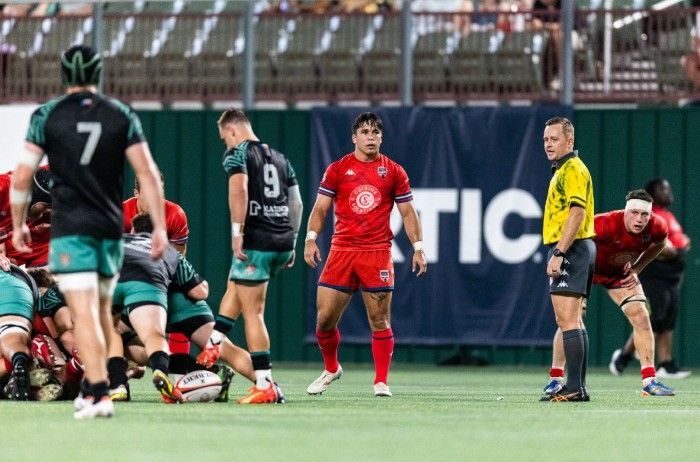
KoiKoi Nelligan during DC Old Glory’s match with the Dallas Jackals
KoiKoi, his youngest son and the West Point graduate, received a waiver from Secretary of Defense Lloyd Austin to play with Old Glory DC of Major League Rugby, You’ll find his dad at games. But he won't be wearing his suit.
"I wore a jacket and tie and khakis to his West Point rugby games but once he was with Old Glory, I figured there were no more examples for me to set," Nelligan tells USA TODAY Sports. "By being in the pros, he was now setting the example for me."
Steve Borelli, aka Coach Steve, has been an editor and writer with USA TODAY since 1999. He spent 10 years coaching his two sons’ baseball and basketball teams. He and his wife, Colleen, are now sports parents for a high schooler and middle schooler. His column is posted weekly. For his past columns, click here.
Got a question for Coach Steve you want answered in a column? Email him at sborelli@usatoday.com