"Eric Stratton, Rush Chairman. Damn glad to meet you."
The most complex character in American cinematic history.
“Eric Stratton” may be one of the most complex character roles ever envisioned in the history of filmmaking. And no, that’s not hyperbole. Just ask him.
How do we reconcile his immense charisma and movie-star looks with his wretched pathological misogyny and manipulation? Even his nickname reveals his persona: Otter – the slippery mammal, sleek and muscular, always obstructing natural waterways. His dominating character leads his Delta House brothers into a climactic crescendo of cascading catastrophes (whoa), ultimately plunging everyone and everything into total nihilism. Even if the whole point is just to have fun.
We find his unprecedented screen power mesmerizing; hypnotically, he forces us to root for Delta and cheer for demise of Omega. Some say you can’t make this up. But it was.
In the eyes of many scholars, Eric Stratton is the chief catalyst for the film. Along with other chief catalysts. Who is he? Let’s find out...
________________
“Damn glad to meet you.”
We first meet him in his Playboy pad, circa 1955. He’s oblivious to the Pledge party downstairs, focused as he is on upcoming debauchery. In the midst of revealing a grotesque phallic sex toy to his sidekick Boon, Otter is chided by Delta Tau Chi President Robert Hoover: “There are people trying to get into this fraternity. Otter, you are the rush chairman. You
should be present at the rush party.”
Shortly after, Otter will spin through the packed and squalid Delta house, reeking of insincerity and guile. “Eric Stratton, rush chairman, damn glad to meet you” he repeats untruthfully to several would-be pledges.
On a personal note and outside the scope of the submission parameters for those excellent editors of the Journal of Post-Modern Dualities, the following scene below remains one of the author’s favorites for its glimpse into Otter’s gestalt.
In the midst of his walk through the Delta bedlam Otter seizes upon Kent Dorfman’s tie, commenting on the upscale Rayon fabric and asking if Kent’s mother bought it for him. Then, as just recounted in Chapter 1, he goes on to deride Kent’s closet-case older brother Fred and then vanishes. But not before making fun of Boon and Katy during a silly tiff about their long-term future together.
Despite this obvious cruelty and self-obsession, we like him. Why? Again, good question.
____________________
“Frank Lyman from Amherst. Fawn’s fiancé”
Fast forwarding, because we can, we find that Delta House has been kicked off campus, the entire contents of the fraternity has been confiscated (even the stuff they didn't steal), and Otter responds to it all in typically nihilistic fashion: "Road trip." We now reel down the road in closet-case Fred Dorfman’s Lincoln Continental, staggered by the pace of events.
It’s on this breathtaking ride that Otter instructs Pinto and Flounder on the keys to success with girls from Emily Dickinson College: “Mention modern art, civil rights or folk music and you're in like Flynn.” It’s a timeless observation and still works today with GenZ. And if that’s not enough to race our old-school misogynistic hearts, Otter then glances at a newspaper and effortlessly brings treachery, as Boon once commented, to a brand new low.
That’s because Fawn Leibovitz may have perished in a tragic kiln accident but she’s just another piece of female clay for Otter to shape.
He enters the Emily Dickinson College girls’ dorm (whistling Russian composer Sergei Prokofiev’s deadly “Peter the Wolf”), greets the perfectly named Brunella at the reception desk and asks to see Fawn. Panicked, Brunella phones the full-bodied Shelly Dubinsky and whispers that she has to come down and break the terrible news about the former potter to her fiancé, Frank Lyman from Amherst.
When Shelly informs Frank of the ceramic furnace explosion, he endearingly processes it the only way he knows how: “She was going to make a pot for me.”
Of course we know as Frank tells us, that Frank can’t be alone tonight. The shapely Shelly goes to get her coat but not before Frank asks with teary eyes, “And can you get three dates for my friends?”
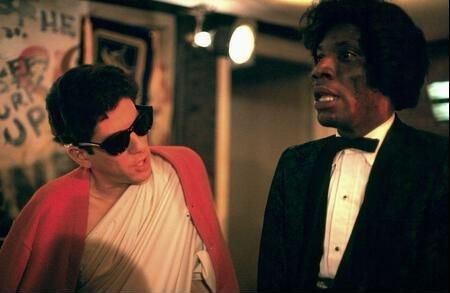
The octet travels to the Dexter Lake Club, an African American cultural center (covered extensively in Chapter 5), where
20 minutes later Frank is in the backseat of Fred Dorfman’s car. With the curvaceous Shelly....